Swiss Alps Property Guide
Swiss Alps property guide: explore luxury real estate in St. Moritz, Gstaad, Verbier and Zermatt, with prices, Lex Koller rules, yields and tax insights.…
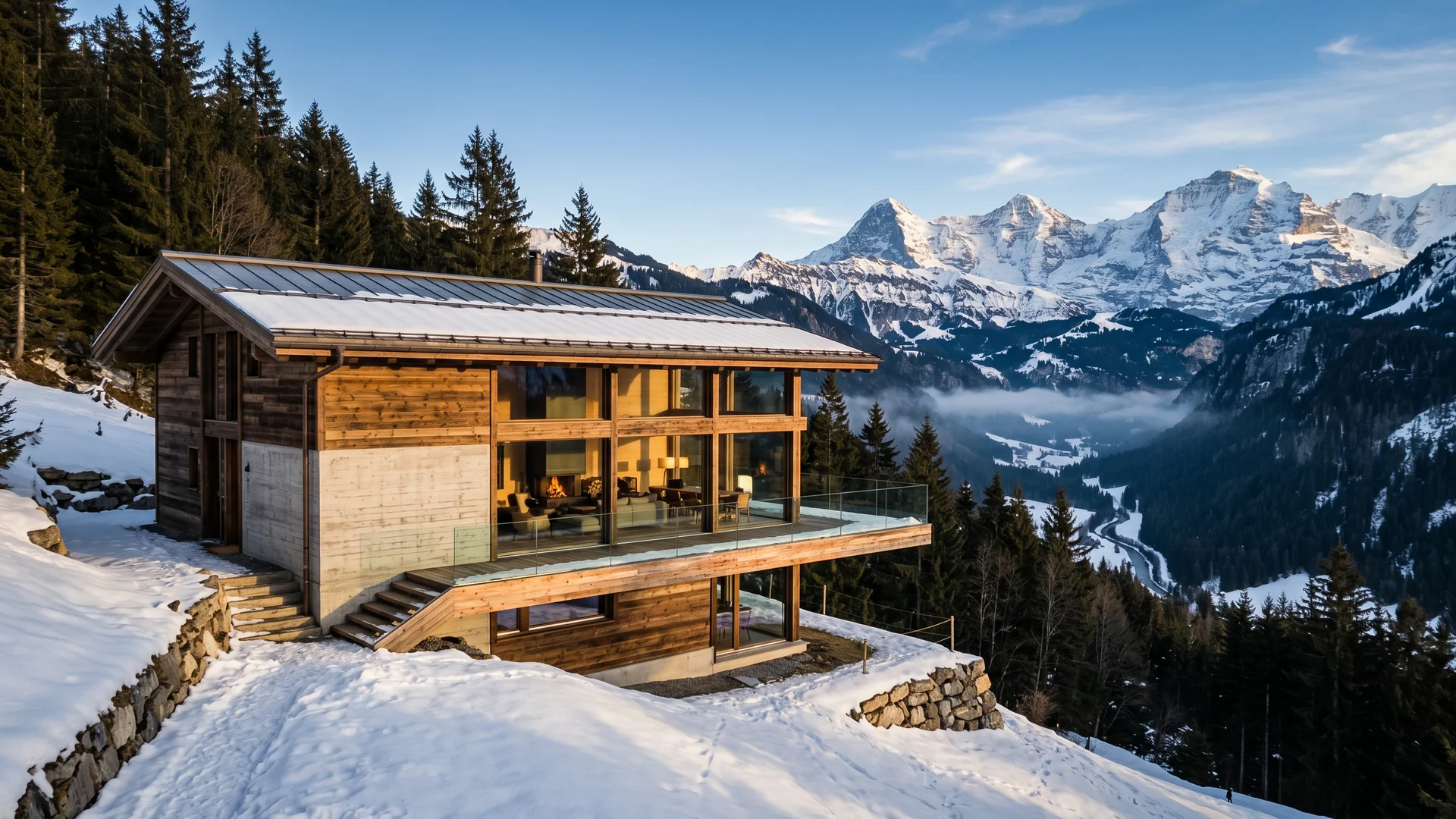

The Swiss Alps luxury property market, worth about CHF 85 billion, spans elite resorts like St. Moritz, Gstaad, Verbier and Zermatt, prized for stability, discretion and capital preservation.
Key Takeaways
- The Swiss alpine luxury market across Graubünden, Bern, Valais and Vaud is valued at roughly CHF 85 billion in residential stock, with luxury transactions above CHF 5 million totalling around CHF 3.5 billion annually.
- Prime alpine residential prices have appreciated 3.5 to 5 percent per year over the past decade, and values have roughly doubled over twenty years at about 3.5 percent compound annual growth.
- St. Moritz commands CHF 25,000 to CHF 55,000 per square metre, with top chalets in the Suvretta, Kulm and El Paradiso enclaves reaching CHF 30 million to CHF 80 million.
- Gstaad enforces strict chalet-style building rules and prices prime chalets at CHF 30,000 to CHF 60,000 per square metre, with the most prestigious addresses valued up to CHF 100 million.
- The Lex Koller restricts non-resident foreigners to designated tourist zones under scarce cantonal quotas, often capping net living space at 200 square metres, with C-permit holders exempt.
- Gross rental yields run 2 to 4 percent and peak winter weekly chalet rates range from CHF 15,000 to CHF 120,000, making the market a capital-preservation rather than high-yield asset.
- High-altitude resorts like Zermatt (glacier skiing to 3,899 metres), St. Moritz (3,305 metres) and Verbier (3,330 metres) are best positioned against climate-driven snow loss.
Swiss Alps Property Guide: Investing in Alpine Excellence
The Swiss Alps represent the apex of alpine luxury real estate, a market defined by breathtaking natural beauty, legendary discretion, exceptional build quality, and the unmatched stability of the Swiss Confederation. From the jet-set glamour of St. Moritz to the understated elegance of Gstaad, from the family-friendly sophistication of Verbier to the cosmopolitan charm of Zermatt, the Swiss Alps offer a diversity of resort experiences unified by a common standard of excellence that is recognised worldwide. The Swiss alpine luxury property market — encompassing the cantons of Graubünden, Bern, Valais, and Vaud — is valued at approximately CHF 85 billion (€87 billion) in total residential stock, with annual transaction volumes in the luxury segment (above CHF 5 million / €5.1 million) of approximately CHF 3.5 billion (€3.6 billion). The market has demonstrated consistent growth, with prime alpine residential prices appreciating by an average of 3.5 to 5 percent annually over the past decade.
The Premier Alpine Resorts
St. Moritz
St. Moritz, in the Engadin valley of the canton of Graubünden, is the undisputed grande dame of Swiss alpine resorts. The birthplace of winter tourism (hosting the first winter visitors in 1864) and twice host of the Winter Olympics (1928 and 1948), St. Moritz has cultivated an aura of exclusivity for over 150 years. The resort divides into two distinct areas: St. Moritz Dorf (the village), perched on a sunny terrace above the lake, and St. Moritz Bad (the spa district), at lake level. Prime properties in St. Moritz Dorf — particularly apartments and chalets with views of Lake St. Moritz and the Corviglia ski area — command CHF 25,000 to CHF 55,000 per square metre (€26,000 to €57,000). A luxury four-bedroom penthouse of 250 square metres with lake views in St. Moritz Dorf would typically list at CHF 7 million to CHF 14 million (€7.2 million to €14.4 million). The resort's most exceptional properties — chalets in the Suvretta area, the Kulm, and the El Paradiso enclave — can reach CHF 30 million to CHF 80 million (€31 million to €82 million). St. Moritz benefits from the highest density of five-star hotels in the Swiss Alps (Badrutt's Palace, Kulm Hotel, Suvretta House, Carlton Hotel, and the Kempinski Grand Hotel des Bains) and a social calendar anchored by events such as the White Turf horse races on the frozen lake, the Snow Polo World Cup, and the annual St. Moritz Art Masters.
Gstaad
Gstaad, in the Bernese Oberland, presents itself as the most discreet and aristocratic of Swiss alpine resorts. The Saanenland region, encompassing the villages of Gstaad, Saanen, Schönried, and Rougemont, has been a favoured retreat of European royalty, aristocracy, and business dynasties for generations. Gstaad's strict architectural regulations — requiring traditional chalet-style construction, limiting building heights, and restricting exterior design — have preserved the region's aesthetic integrity and exclusivity. Prime chalets in Gstaad command CHF 30,000 to CHF 60,000 per square metre (€31,000 to €62,000). A substantial five-bedroom chalet of 400 square metres with mountain views in the Oberbort or Wispilenstrasse areas would list at CHF 12 million to CHF 25 million (€12.3 million to €25.7 million). The most prestigious addresses — the chalets of the Oberbort, the Wispilenstrasse, and the Gsteig area — feature properties valued at CHF 20 million to CHF 100 million (€20.5 million to €103 million). Gstaad's appeal is enhanced by its year-round lifestyle: exceptional skiing in winter, the Gstaad Menuhin Festival and ATP tennis tournament in summer, and a concentration of luxury boutiques, gourmet restaurants (including the Michelin-starred Sommet and the historic Chesery), and five-star hotels (the Gstaad Palace, the Alpina Gstaad, and Le Grand Bellevue).
Verbier
Verbier, in the canton of Valais, is the Swiss Alps' most dynamic and internationally oriented luxury resort. Known for its extensive and challenging ski terrain (linking into the vast Four Valleys ski area), its vibrant après-ski and nightlife scene, and its appeal to a younger, more entrepreneurial international clientele, Verbier has become particularly popular with British, Scandinavian, and increasingly Middle Eastern buyers. Luxury chalets in Verbier command CHF 20,000 to CHF 45,000 per square metre (€20,500 to €46,000). Prime chalets in the most desirable locations — the Hameau development, the Chalet d'Adrien area, and the Savoleyres sector — sell for CHF 8 million to CHF 30 million (€8.2 million to €31 million). The resort has attracted significant investment in luxury hotels (W Verbier, Experimental Chalet) and branded residences (W Residences Verbier, Six Senses Residences in Crans-Montana, a sister resort). Verbier's international accessibility (approximately two hours from Geneva) and the English-speaking character of the resort contribute to its appeal for global buyers.
Zermatt
Zermatt, at the foot of the iconic Matterhorn in the canton of Valais, offers a unique proposition: a car-free alpine village of extraordinary natural beauty with some of Europe's highest and most snow-sure skiing. The resort's architectural character — traditional Valaisian chalets and barns (raccards) built from dark, weathered larch wood, combined with increasingly sophisticated contemporary chalets — creates a distinctive aesthetic. Prime chalets and apartments in Zermatt command CHF 22,000 to CHF 50,000 per square metre (€22,600 to €51,000). Properties with Matterhorn views command premiums of 30 to 50 percent. A luxury chalet of 350 square metres with Matterhorn views in the Winkelmatten or Findeln areas would list at CHF 9 million to CHF 22 million (€9.2 million to €22.6 million). Zermatt's appeal is enhanced by its year-round glacier skiing, its exceptional mountain restaurant scene (including Chez Vrony and Findlerhof), and its access to the Cervinia ski area in Italy, accessible from the Klein Matterhorn lift.
Crans-Montana and Andermatt
Crans-Montana, also in Valais, has experienced a renaissance driven by the new Six Senses Residences and the Etrier development, attracting a younger international buyer profile. Luxury chalets and apartments sell for CHF 15,000 to CHF 30,000 per square metre (€15,400 to €31,000). Andermatt, in the canton of Uri, represents Switzerland's most ambitious recent alpine development. The Andermatt Swiss Alps project, initiated by Egyptian investor Samih Sawiris, has transformed this former military base into a year-round luxury resort featuring the Chedi Andermatt hotel, an 18-hole championship golf course, and a growing collection of luxury apartments and chalets. Prices in Andermatt range from CHF 12,000 to CHF 25,000 per square metre (€12,300 to €25,700), representing a value proposition relative to the established premium resorts.
The Lex Koller and Ownership Restrictions
The Swiss federal law on the acquisition of real estate by persons abroad — the Lex Koller — is the foundational regulatory constraint on international alpine property investment. The law restricts the acquisition of residential property in Switzerland by non-resident foreign nationals and, critically, limits the sale of property in designated tourist areas to non-residents through a quota system. In practice, the Lex Koller means that: non-resident foreigners can generally only purchase property in designated tourist zones (including most major alpine resorts), subject to annual cantonal quotas; the quotas are limited — each canton receives an allocation of permits, and available permits can be extremely scarce in high-demand resorts; properties purchased under the Lex Koller are typically subject to restrictions on floor area (often limited to 200 square metres of net living space) and on the number of units that can be owned; and EU and EFTA nationals with Swiss residence permits, and foreign nationals holding a Swiss C permit (permanent residence), are exempt from the Lex Koller restrictions. Navigating the Lex Koller requires specialist legal advice. The availability of permits varies by canton and by resort, and strategies exist for structuring ownership to comply with the law while achieving the buyer's objectives. The quota system creates scarcity value for Lex Koller-compliant properties, which can command premiums over properties available only to Swiss residents.
Investment Performance and Rental Dynamics
Swiss alpine property has historically been a capital preservation asset rather than a high-yield investment. Gross rental yields for luxury chalets range from 2 to 4 percent, depending on location, property quality, and the intensity of rental marketing and management. The highest yields are achieved in resorts with strong year-round demand — notably Zermatt (year-round skiing) and St. Moritz and Gstaad (summer seasons almost as strong as winter). Peak winter weekly rental rates for luxury chalets range from CHF 15,000 to CHF 120,000 (€15,400 to €123,000). The Swiss franc's status as a safe-haven currency has historically supported property values, with the franc's appreciation against the euro and other currencies enhancing returns for international investors. Capital appreciation, while less dramatic than in some emerging luxury markets, has been consistent: prime alpine residential property values have roughly doubled over the past twenty years, representing a compound annual growth rate of approximately 3.5 percent, with periods of stronger growth during the global financial recovery and the post-pandemic alpine property boom.

Taxation for Property Owners
Switzerland's tax system is characterised by significant cantonal and municipal autonomy, meaning that the tax treatment of alpine property owners varies considerably depending on the property's location. Key elements include: annual wealth tax levied by cantons on the tax value of the property (which is typically well below market value), with rates varying from approximately 0.1 percent to 0.5 percent; an imputed rental income tax (Eigenmietwert) for owner-occupied properties, taxed as income based on a notional rental value (though proposals to abolish this tax are under discussion); property transfer tax (Handänderungssteuer) at rates varying by canton (1 to 3 percent, with some cantons exempting certain transfers); no federal capital gains tax on property, though cantons levy capital gains taxes on property sales with rates that typically decrease the longer the property has been held (common schedules reduce the rate from approximately 30 percent for properties held less than a year to zero after 20 to 25 years of ownership); and the possibility of lump-sum taxation (Pauschalbesteuerung or forfait fiscal) for non-working foreign residents, calculated based on the taxpayer's living expenses rather than worldwide income and assets, available in several cantons (though abolished or restricted in others). This lump-sum regime has historically been a significant attraction for high-net-worth individuals relocating to Swiss alpine resorts. The Swiss property tax framework, combined with the country's political stability, currency strength, and high quality of life, creates a compelling proposition for ultra-high-net-worth individuals seeking to establish a Swiss fiscal residence through alpine property ownership.
Climate Change and the Future of Alpine Property
The impact of climate change on alpine property values is a subject of increasing focus and debate. Rising temperatures are affecting snow reliability at lower altitudes, with implications for the skiing proposition that underpins much of the alpine luxury market. The Swiss resorts best positioned to withstand these changes are those with high-altitude skiing — Zermatt (glacier skiing to 3,899 metres), St. Moritz (skiing to 3,305 metres), and Verbier (skiing to 3,330 metres, with the highest ski area in the Four Valleys). Lower-altitude resorts and those without reliable snowmaking infrastructure face greater challenges. Swiss resorts are responding with significant investments in snowmaking, year-round attractions (hiking, mountain biking, golf, culture), and repositioning as summer destinations. The summer alpine luxury market — hiking, mountain biking, road cycling, golf, outdoor gastronomy, and cultural festivals — is growing rapidly and partially offsetting winter vulnerability. Buyers should consider altitude, snow reliability, and the resort's investment in climate adaptation as key factors in property selection.
Conclusion
Swiss alpine luxury property occupies a unique and exalted position in the global real estate landscape. It combines the aesthetic and experiential superlatives of the Alps — the Matterhorn, the Engadin lakes, the Bernese Oberland peaks — with the institutional superlatives of Switzerland: political stability, economic strength, fiscal attractiveness, and the rule of law. For international buyers who can navigate the Lex Koller restrictions and who value capital preservation, discretion, and the multi-generational stewardship of a family alpine property, the Swiss Alps offer an unmatched proposition. As global wealth continues to grow and as the search for safe-haven assets intensifies, Swiss alpine property is likely to maintain and enhance its position as one of the world's most desirable and resilient luxury real estate markets.
Frequently Asked Questions (FAQ)
How much does luxury property cost in St. Moritz?
Prime properties in St. Moritz Dorf command CHF 25,000 to CHF 55,000 per square metre. A 250-square-metre four-bedroom penthouse with lake views typically lists at CHF 7 million to CHF 14 million, while exceptional chalets in the Suvretta, Kulm and El Paradiso enclaves can reach CHF 30 million to CHF 80 million.
What is the Lex Koller and how does it affect foreign buyers in the Swiss Alps?
The Lex Koller is the Swiss federal law restricting real estate acquisition by persons abroad. Non-resident foreigners can generally only buy in designated tourist zones, subject to scarce annual cantonal quotas, with properties often capped at 200 square metres of net living space. EU and EFTA nationals with Swiss residence and C-permit holders are exempt.
Why is Gstaad considered the most exclusive Swiss alpine resort?
Gstaad, in the Bernese Oberland, is the most discreet and aristocratic Swiss resort, long favoured by European royalty and business dynasties. Strict architectural rules require traditional chalet construction and limit building heights, preserving its exclusivity. Prime chalets cost CHF 30,000 to CHF 60,000 per square metre, with the most prestigious addresses valued up to CHF 100 million.
What makes Verbier popular with international property buyers?
Verbier, in Valais, is the Swiss Alps' most dynamic and internationally oriented resort, with challenging ski terrain in the Four Valleys area and a lively nightlife. It appeals to younger British, Scandinavian and Middle Eastern buyers, helped by its English-speaking character and location roughly two hours from Geneva. Luxury chalets cost CHF 20,000 to CHF 45,000 per square metre.
How does Zermatt's Matterhorn location affect property prices?
Zermatt is a car-free village at the foot of the Matterhorn with snow-sure, year-round glacier skiing. Prime chalets and apartments command CHF 22,000 to CHF 50,000 per square metre, and properties with Matterhorn views carry premiums of 30 to 50 percent. A 350-square-metre chalet with Matterhorn views in Winkelmatten or Findeln lists at CHF 9 million to CHF 22 million.
What rental yields can Swiss alpine luxury chalets generate?
Swiss alpine property is primarily a capital-preservation asset, with gross rental yields ranging from 2 to 4 percent depending on location, quality and management. The highest yields come from resorts with strong year-round demand such as Zermatt, St. Moritz and Gstaad. Peak winter weekly rental rates for luxury chalets range from CHF 15,000 to CHF 120,000.
How is property taxed for owners in the Swiss Alps?
Taxation varies by canton and municipality. Cantons levy annual wealth tax of about 0.1 to 0.5 percent, an imputed rental income tax on owner-occupied homes, and property transfer tax of 1 to 3 percent. There is no federal capital gains tax, and cantonal capital gains rates decrease with holding time. Lump-sum taxation is available to non-working foreign residents in several cantons.
Which Swiss alpine resorts are most resilient to climate change?
Resorts with high-altitude skiing are best positioned against declining snow reliability. The article highlights Zermatt, with glacier skiing to 3,899 metres, St. Moritz, with skiing to 3,305 metres, and Verbier, reaching 3,330 metres in the Four Valleys. Swiss resorts are also investing in snowmaking and year-round summer attractions like hiking, golf and cultural festivals.
More from Switzerland
Choosing Between Urban and Rural Living in Switzerland
Urban living in Switzerland offers a unique blend of modernity and tradition, characterized by vibrant city life, cultural diversity, and a plethora o…
Pricing Strategies for Apartments and Chalets in Switzerland
The Swiss real estate market is characterized by its unique blend of stability, high demand, and a diverse range of properties. Switzerland’s po…
Top Properties with Mountain Views as Investment Opportunities in Switzerland
Switzerland is renowned for its breathtaking landscapes, and the allure of mountain views is a significant draw for both tourists and potential proper…