Berlin Luxury Property Market
Berlin luxury property market guide: EUR 3.8 billion in 2025 transactions, prime prices of EUR 12,000 to 18,000 per square metre, top neighbourhoods, taxes and risks.…
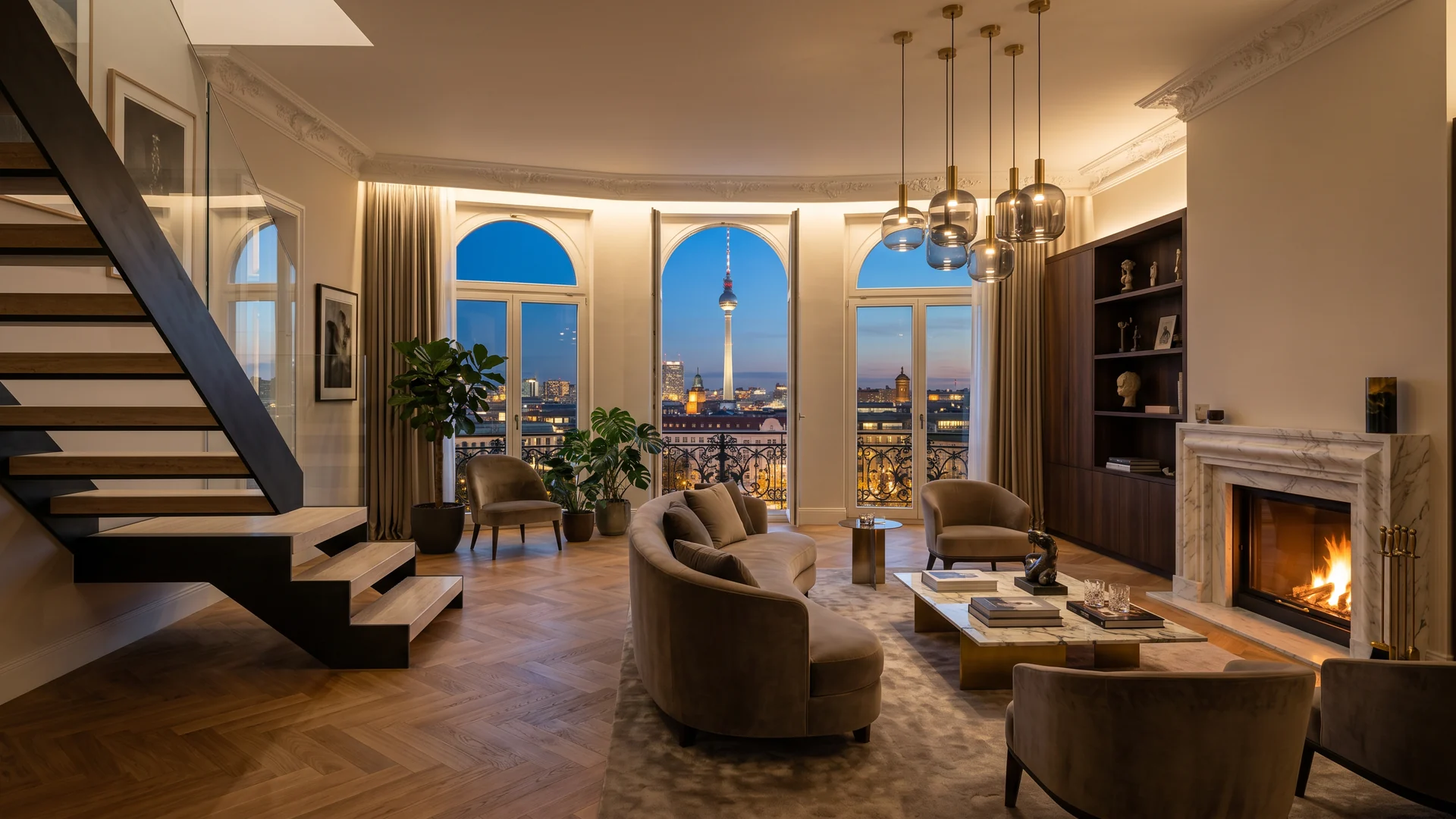

Berlin's luxury property market, defined as homes above EUR 1.5 million, recorded roughly EUR 3.8 billion in transactions in 2025, with prime prices of EUR 12,000 to 18,000 per square metre.
Key Takeaways
- Berlin's luxury residential market is defined as properties above EUR 1.5 million and recorded approximately EUR 3.8 billion in transactions in 2025, about 12 percent of total residential value.
- Prime residential prices in Berlin's most desirable neighbourhoods average EUR 12,000 to 18,000 per square metre and are growing 5 to 7 percent annually, a fraction of London, Paris, or Munich.
- Mitte is Berlin's most established luxury district, with prime apartments at EUR 12,000 to 22,000 per square metre and prestige penthouses reaching EUR 18,000 to 30,000 per square metre.
- Berlin's southwest villa colonies in Grunewald, Zehlendorf, Dahlem, and Wannsee price from EUR 3 million to 20 million, with lakefront villas commanding 30 to 50 percent premiums.
- Total closing costs run 9 to 12 percent of the purchase price, including 6 percent Grunderwerbsteuer, and capital gains are exempt after ten years of ownership.
- Home ownership in Berlin is around 17 percent versus the German average of about 47 percent, and luxury apartments yield modest gross returns of 2.5 to 3.5 percent.
- Key risks include rent controls like the Mietpreisbremse, the 2021 Deutsche Wohnen expropriation referendum, tech-sector reliance, and a less liquid super-prime market above EUR 5 million.
Berlin Luxury Property Market: Europe's Most Dynamic Capital
Berlin's luxury property market has undergone a remarkable transformation over the past two decades, evolving from a post-reunification value opportunity into one of Europe's most sophisticated and sought-after residential investment destinations. As the capital of Europe's largest economy and a global hub for technology, culture, and politics, Berlin attracts a diverse international buyer base drawn by the city's unique combination of cosmopolitan energy, creative spirit, and relative affordability compared to other global capitals. The Berlin luxury residential market — defined as properties above €1.5 million — recorded transaction volumes of approximately €3.8 billion in 2025, representing roughly 12 percent of total residential transactions by value. Prime residential prices in Berlin's most desirable neighbourhoods averaged €12,000 to €18,000 per square metre, a fraction of comparable properties in London, Paris, or Munich, but growing at an annual rate of 5 to 7 percent.
The Geography of Berlin Luxury
Berlin's luxury property geography reflects the city's polycentric structure, a legacy of its divided history and its evolution as a city of distinct neighbourhoods (Kieze) rather than a single dominant centre.
Mitte and the Historic Centre
Mitte, the central borough encompassing Berlin's historic core, represents the city's most established luxury residential district. The area around Unter den Linden, the Gendarmenmarkt, and the Spree riverfront offers grand historic apartment buildings (Altbauten) that have been meticulously restored and modernised. Prime apartments in this zone command €12,000 to €22,000 per square metre, with penthouse residences in prestige buildings such as the Kronprinzengärten, the Palais Varnhagen, and the newly developed Am Zirkus achieving €18,000 to €30,000 per square metre. A 200-square-metre three-bedroom Altbau apartment with stucco ceilings, herringbone parquet flooring, and views of the Gendarmenmarkt would typically list at €2.5 million to €5 million. The area around Hackescher Markt and the Spandauer Vorstadt offers a more bohemian-luxury character, with restored nineteenth-century apartment buildings, courtyard access, and proximity to Berlin's best restaurants, galleries, and boutiques.
Charlottenburg and the West Berlin Legacy
Charlottenburg, the historic centre of former West Berlin, retains its status as a bastion of established wealth and elegance. The area around Kurfürstendamm, Fasanenstrasse, and the streets bordering the Tiergarten and the Lietzensee offers spacious pre-war apartments and villas that appeal to a more traditional, often older buyer demographic. Prime Altbau apartments in Charlottenburg sell for €10,000 to €18,000 per square metre. The iconic Ku'Damm, with its luxury retail and five-star hotels, anchors the neighbourhood's luxury appeal. The adjacent neighbourhoods of Wilmersdorf and Schmargendorf offer townhouses and villas that are among Berlin's most valuable freestanding properties, with prices of €2 million to €8 million for substantial family homes.
Prenzlauer Berg and the East Berlin Renaissance
Prenzlauer Berg, the heart of former East Berlin, has experienced one of Europe's most dramatic gentrification narratives. From a dilapidated working-class district in the 1990s to Berlin's epicentre of young family life and creative entrepreneurship, Prenzlauer Berg now features extensively restored Altbauten with high ceilings, ornate stucco detailing, and the district's characteristic wide, tree-lined streets. Luxury apartments in the area around Kollwitzplatz and Helmholtzplatz command €10,000 to €16,000 per square metre. The neighbourhood's excellent schools, abundant green spaces, and vibrant café and restaurant culture make it Berlin's most family-oriented luxury district.
Kreuzberg, Friedrichshain, and the Creative Luxury Frontier
Kreuzberg and Friedrichshain, historically Berlin's alternative and countercultural heartlands, have seen increasing luxury development alongside the preservation of their distinctive character. The area along the Landwehrkanal and the Spree in Kreuzberg has attracted architect-designed new-build developments and industrial conversions that appeal to buyers seeking a more edgy, culturally rich environment. Prices for high-end properties in these districts range from €8,000 to €14,000 per square metre, representing a value proposition relative to Mitte and Charlottenburg. The Mediaspree development along the Spree riverbanks has transformed former industrial zones into modern residential and commercial districts.
Zehlendorf, Grunewald, and the Villa Colonies
Berlin's southwest — the districts of Zehlendorf, Grunewald, Dahlem, and Wannsee — represents the city's most established suburban luxury market. These areas, characterised by lakes, forests, and substantial villas on generous plots, have been favoured by Berlin's political, diplomatic, and business elite for over a century. The villa colonies of Grunewald, with their distinctive pre-war and modernist architecture, offer properties typically priced from €3 million to €20 million. Lakefront villas on the Wannsee and the Griebnitzsee command premiums of 30 to 50 percent over comparable inland properties. The area's excellent international schools (including the JFK School and the Berlin British School) and proximity to the Grunewald forest and the Havel lakes make it Berlin's premier family-oriented luxury district.

New Development and Contemporary Architecture
Berlin's new-build luxury segment has lagged behind many European capitals historically but is now catching up. Significant projects include: the Quartier 206 and Quartier 207 developments on Friedrichstrasse, combining luxury retail, offices, and high-end residential; the Living Levels tower on the Spree in Friedrichshain, offering 34 floors of luxury apartments with panoramic city views; the Upper West tower and Waldorf Astoria residences near the Gedächtniskirche in Charlottenburg; the Schützenquartier development in Mitte, offering contemporary luxury apartments adjacent to the Spree; and numerous boutique developments in Prenzlauer Berg and Mitte that blend contemporary design with Berlin's characteristic courtyard typology. New-build luxury properties command premiums of 15 to 25 percent over comparable period properties, reflecting buyer preferences for modern building services, energy efficiency, and the elevator, parking, and security amenities that many historic buildings lack.
The International Buyer Profile
Berlin's international buyer base has diversified significantly. While historically dominated by Western Europeans — particularly from the UK, France, Italy, and the Nordic countries — recent years have seen significant increases in buyers from the United States (drawn by Berlin's tech ecosystem and relative affordability), the Middle East, Eastern Europe (particularly Poland and the Czech Republic), and increasingly from Asia. The city's status as a global technology hub — home to companies such as Zalando, Delivery Hero, HelloFresh, and N26, and the European headquarters of Google and Amazon — attracts a steady stream of well-compensated professionals who form the backbone of the mid-luxury market. International buyers are drawn by Berlin's cultural vibrancy, its well-preserved architectural heritage, its exceptional green spaces and quality of life, and the perception — increasingly validated by market performance — that Berlin luxury property remains undervalued relative to other global capitals.
Rental Market and Investment Yields
Berlin's rental market is a defining feature of its property landscape. The city has historically been a 'city of renters', with home ownership rates among the lowest in Germany at approximately 17 percent (compared to the national average of approximately 47 percent). This creates a deep and liquid rental market, though yields in the luxury segment are modest by commercial standards. Luxury apartments in prime locations achieve gross rental yields of 2.5 to 3.5 percent. A high-quality three-bedroom apartment in Mitte or Charlottenburg rents for €3,500 to €8,000 per month unfurnished, with furnished short-term rentals commanding significant premiums. Berlin's strict rent control measures — the Mietpreisbremse (rent brake) and the Mietendeckel debate (though the latter was ruled unconstitutional) — have introduced regulatory complexity that investors must navigate. However, these regulations apply primarily to existing rental contracts and new-build luxury properties are often exempt from the most restrictive provisions, creating a differentiated market environment.

Regulatory and Tax Framework
Property acquisition in Germany involves the following transaction costs: Estate Agent Commission (Maklerprovision) of 3.57 to 7.14 percent of the purchase price (typically shared between buyer and seller since 2020 reforms, with the buyer's share capped at 50 percent of the total); Property Transfer Tax (Grunderwerbsteuer) at 6 percent in Berlin (increased from 4.5 percent in 2014); Notary and Land Registry Fees of approximately 1.5 to 2 percent; and legal fees (if engaging a lawyer) of 1 to 2 percent. Total closing costs therefore approximate 9 to 12 percent of the purchase price. Germany imposes no annual wealth tax. Capital gains tax on property sales is levied at the individual income tax rate (up to 45 percent plus solidarity surcharge) on properties held for less than ten years; properties held for ten years or more are exempt from capital gains. Owner-occupied properties sold after at least two years of personal occupancy by the seller are also exempt. Ongoing property taxes (Grundsteuer) are modest by international standards, typically €500 to €2,000 annually for luxury apartments. Rental income is taxed as personal income, with deductions available for mortgage interest, depreciation (2 percent per annum for buildings constructed after 1924, 2.5 percent for older buildings), and operating expenses. Inheritance and gift tax in Germany applies with allowances based on the relationship between donor and recipient, ranging from €20,000 for non-relatives to €500,000 for spouses. The German tax system rewards long-term ownership, and the capital gains exemption after ten years is a powerful incentive for buy-and-hold investment strategies.
Market Risks and Considerations
Berlin's luxury property market, while dynamic and promising, is not without significant risks. The city's political environment is distinctly left-leaning, and housing policy is a perennial and highly charged political issue. The 2021 referendum to expropriate large corporate landlords (Deutsche Wohnen & Co enteignen), while not binding and facing legal and political obstacles, signalled the political volatility of Berlin's housing market. Future regulatory interventions — rent controls, conversion restrictions, or changes to land-use planning — could impact property values and investment returns. Berlin's economy, while dynamic, is less diversified than those of financial centres such as London or Frankfurt and is heavily reliant on the technology and creative sectors. An economic downturn affecting the tech industry could disproportionately impact Berlin. The city's population growth, which has driven property demand over the past two decades, may moderate as demographic trends evolve and remote work enables professionals to live further from urban centres. Finally, Berlin's luxury market is less mature and less liquid than those of London, Paris, or Munich, with fewer transactions in the super-prime segment (above €5 million) which can complicate valuation and exit strategies. Despite these risks, Berlin's combination of cultural magnetism, economic dynamism, relative affordability, and strong long-term demographic and economic fundamentals continues to attract international luxury buyers and supports a positive medium to long-term investment thesis.
Conclusion
Berlin's luxury property market occupies a distinctive position in the European landscape. It offers international buyers the opportunity to acquire prime residential real estate in a global capital city at prices that remain substantially below those of London, Paris, or Munich. The city's cultural richness, its status as Europe's leading technology hub, its green spaces and quality of life, and its evolving luxury infrastructure create a compelling lifestyle proposition. The market's relative immaturity and the political complexities of Berlin's housing policy introduce risks that require careful navigation. However, for investors with a long-term perspective and a tolerance for Berlin's unique character — its creative chaos, its intellectual energy, its refusal to be merely a conventional capital city — the Berlin luxury property market offers one of Europe's most interesting and potentially rewarding investment opportunities.
Frequently Asked Questions (FAQ)
How big is the Berlin luxury property market?
The Berlin luxury residential market, defined as properties above EUR 1.5 million, recorded transaction volumes of approximately EUR 3.8 billion in 2025. That represented roughly 12 percent of total residential transactions by value, reflecting Berlin's growing status as one of Europe's most sophisticated and sought-after residential investment destinations.
What are prime property prices per square metre in Berlin?
Prime residential prices in Berlin's most desirable neighbourhoods average EUR 12,000 to 18,000 per square metre, growing 5 to 7 percent annually. In Mitte, prime apartments reach EUR 12,000 to 22,000 per square metre, with prestige penthouses such as the Kronprinzengarten and Palais Varnhagen achieving EUR 18,000 to 30,000.
Which Berlin neighbourhoods are best for luxury real estate?
Mitte is the most established luxury district, while Charlottenburg anchors West Berlin wealth around the Ku'Damm. Prenzlauer Berg is the most family-oriented, Kreuzberg and Friedrichshain offer creative value, and the southwest villa colonies of Grunewald, Zehlendorf, Dahlem, and Wannsee form the premier suburban luxury market.
What are the transaction costs and taxes when buying property in Berlin?
Total closing costs approximate 9 to 12 percent of the purchase price. These include estate agent commission of 3.57 to 7.14 percent, Grunderwerbsteuer property transfer tax of 6 percent in Berlin, notary and land registry fees of 1.5 to 2 percent, and optional legal fees. Germany imposes no annual wealth tax.
Is property in Berlin a good rental investment?
Berlin offers a deep, liquid rental market because home ownership sits near 17 percent versus Germany's roughly 47 percent average. However, luxury yields are modest, with gross rental yields of 2.5 to 3.5 percent. A high-quality three-bedroom apartment in Mitte or Charlottenburg rents for EUR 3,500 to 8,000 per month unfurnished.
How is capital gains tax handled on Berlin property?
Capital gains tax applies at the individual income tax rate, up to 45 percent plus solidarity surcharge, on properties held for less than ten years. Properties held for ten years or more are fully exempt. Owner-occupied homes sold after at least two years of personal occupancy are also exempt, rewarding long-term buy-and-hold strategies.
Why is Berlin luxury property cheaper than London or Paris?
Berlin's luxury market is less mature and less liquid than London, Paris, or Munich, with prime prices of EUR 12,000 to 18,000 per square metre, a fraction of those capitals. Its polycentric structure, post-reunification history, and 'city of renters' character kept values lower, though buyers increasingly view it as undervalued.
What are the main risks of investing in Berlin luxury property?
Key risks include left-leaning housing policy and rent controls like the Mietpreisbremse, plus the 2021 Deutsche Wohnen expropriation referendum signalling political volatility. Berlin's economy relies heavily on tech and creative sectors, population growth may moderate, and the super-prime segment above EUR 5 million is less liquid, complicating valuation and exit.

More from Berlin
Understanding Agent Fees in Berlin: What Buyers and Sellers Should Know
Berlin, the vibrant capital of Germany, is a city that has seen a remarkable transformation over the past few decades. Once divided by a wall that sym…
Properties with Spree River Views: Top Locations in Berlin
Berlin, the vibrant capital of Germany, is a city that seamlessly blends history, culture, and modernity. One of its most enchanting features is the S…
The Agent’s Role in Selling Luxury Properties in Berlin
Berlin, the vibrant capital of Germany, has emerged as a significant player in the global luxury real estate market. The city’s unique blend of …