Dubai Luxury Real Estate Guide
Dubai luxury real estate guide: 2025 prices for Palm Jumeirah, Emirates Hills and Downtown villas, zero-tax benefits, Golden Visa and the 2026 market outlook.…
In 2025 Dubai surpassed London and New York to become the world's most active super-prime real estate market, with over 435 transactions above $10 million.
Key Takeaways
- Dubai recorded around AED 520 billion (EUR 130 billion) in total residential transactions in 2025, with the luxury segment above AED 10 million accounting for roughly AED 178 billion (EUR 45 billion).
- Palm Jumeirah signature villas sell for AED 30 million to AED 180 million, with exceptional Frond G and Marina-view villas exceeding AED 200 million and the area up 78 percent since 2020.
- Emirates Hills, Dubai's 'Beverly Hills' developed by Emaar around the Montgomerie Golf Course, has villas from AED 25 million to AED 200 million.
- Dubai is the global capital of branded residences with more than 50 projects, including Armani/Casa, Bulgari, Four Seasons and Ritz-Carlton, typically commanding 25 to 40 percent premiums.
- The UAE offers zero percent personal income, capital gains and inheritance tax, plus a 10-year Golden Visa for property investments of AED 2 million or more.
- Transaction costs include a 4 percent Dubai Land Department transfer fee, 2 percent agent commission and no annual property tax, with deals closing in 30 to 60 days.
- Knight Frank forecasts prime residential price growth of 5 to 7 percent in 2026, following roughly 16 percent in 2024 and 20 percent in 2023.
Dubai Luxury Real Estate: A Global Powerhouse Market
Dubai's luxury real estate market has undergone a spectacular evolution over the past two decades, transforming from a speculative emerging market into one of the world's most liquid, transparent, and globally relevant super-prime residential destinations. In 2025, Dubai recorded total residential real estate transaction values of approximately AED 520 billion (€130 billion), with the luxury segment — defined as properties above AED 10 million (€2.5 million) — accounting for approximately AED 178 billion (€45 billion). The emirate's luxury market has been propelled by a confluence of powerful tailwinds: the UAE's political and economic stability in a volatile region, its world-class infrastructure and quality of life, its zero percent personal income tax regime, its Golden Visa programme offering 10-year residency for property investors, and its positioning as a global hub for business, tourism, and culture. In 2025, Dubai surpassed both London and New York to become the world's most active super-prime real estate market, with over 435 transactions above $10 million (€9.2 million), according to Knight Frank.
Prime Locations and Market Segments
Palm Jumeirah
Palm Jumeirah, the iconic man-made archipelago in the shape of a palm tree, remains Dubai's most recognisable luxury residential destination. The crescent and fronds of the Palm offer distinct property types and price points. Signature villas on the fronds — typically five to seven bedrooms with private beach access and panoramic views of the Arabian Gulf and Dubai Marina skyline — sell for AED 30 million to AED 180 million (€7.5 million to €45 million). The most exceptional villas, particularly on Frond G (the 'Golden Mile' of the Palm) and those with Dubai Marina skyline views, have achieved prices exceeding AED 200 million (€50 million). The Palm Jumeirah has seen a remarkable 78 percent price appreciation since 2020, making it one of the world's best-performing luxury residential markets. The Atlantis The Royal Residences, a collection of super-prime apartments and penthouses adjacent to the Atlantis The Royal hotel, have achieved sales of AED 20 million to AED 160 million (€5 million to €40 million).
Emirates Hills
Emirates Hills, often described as Dubai's 'Beverly Hills', is a prestigious gated community built around the Montgomerie Golf Course. Developed by Emaar, the community features custom-built luxury villas on generous plots, many with golf course and lake views. Emirates Hills has long been favoured by Dubai's established business families and international buyers seeking privacy and a mature residential environment. Villa prices range from AED 25 million for older properties requiring renovation to AED 200 million (€50 million) for architect-designed mansions on prime golf-front plots.
Downtown Dubai and Burj Khalifa
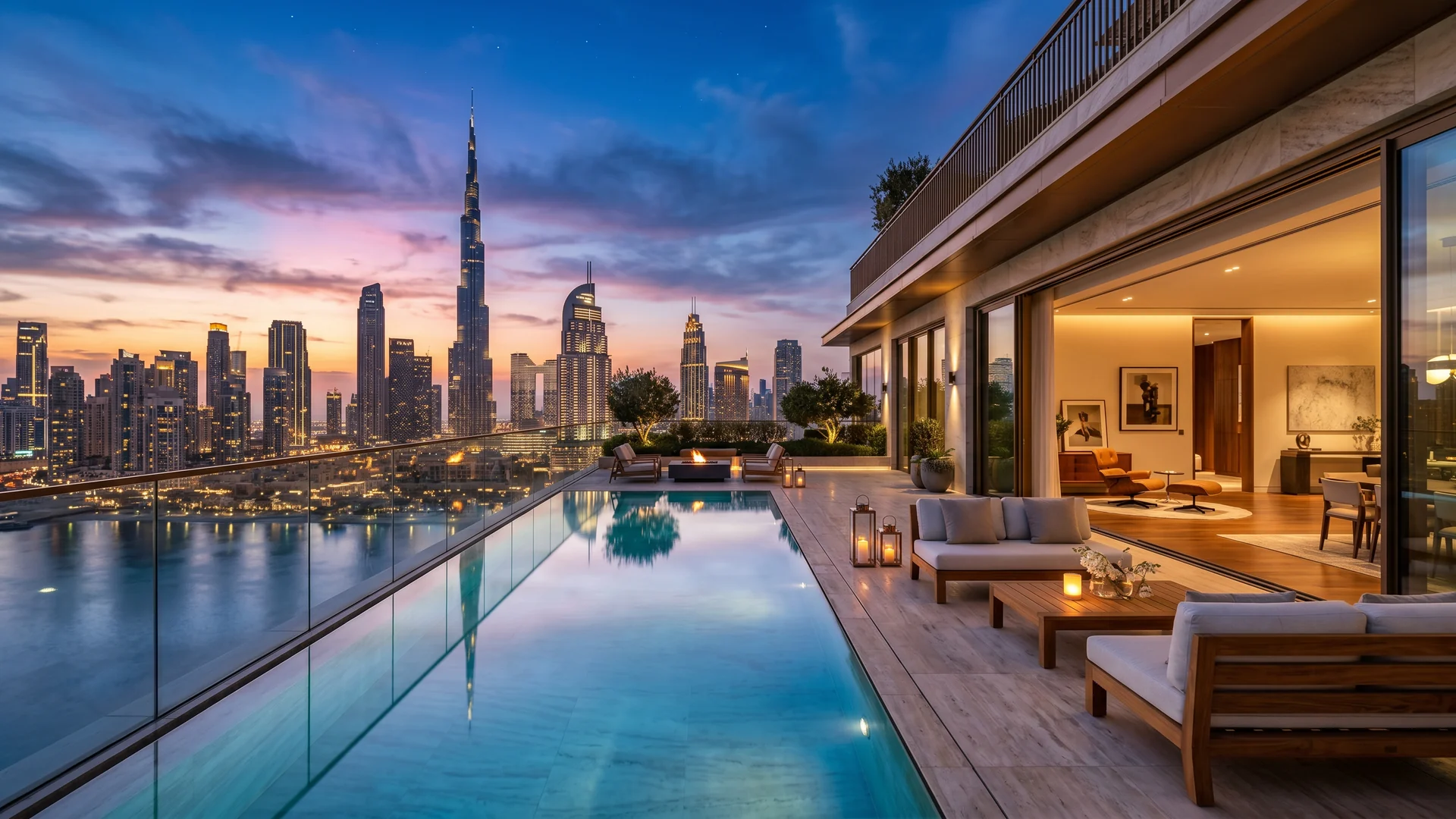
Downtown Dubai, centred on the Burj Khalifa, Dubai Mall, and the Dubai Opera, represents the emirate's urban luxury core. The district offers luxury apartments and penthouses with direct views of the Burj Khalifa, the Dubai Fountain, and the city skyline. Prime apartments in buildings such as The Address Residences, Burj Khalifa, and the newer Grande and Il Primo towers command AED 3 million to AED 80 million (€750,000 to €20 million). Penthouses in the Burj Khalifa, occupying the world's highest residential floors, have sold for AED 60 million to AED 160 million (€15 million to €40 million).
Jumeirah Bay Island and Bulgari Resort & Residences
Jumeirah Bay Island, a man-made island shaped like a seahorse and connected to Jumeirah Beach Road by a bridge, has emerged as one of Dubai's most exclusive residential enclaves. Developed by Meraas, the island is anchored by the Bulgari Resort & Residences, Marina, and Yacht Club. Bulgari Residences apartments and penthouses sell for AED 12 million to AED 80 million (€3 million to €20 million). The island's collection of ultra-exclusive Bulgari mansions and villas commands AED 60 million to AED 200 million (€15 million to €50 million). Jumeirah Bay Island offers a level of exclusivity and low density that is rare in Dubai's luxury market.
Dubai Hills Estate and Emerging Luxury Communities
Dubai Hills Estate, a joint venture between Emaar and Meraas, represents Dubai's most successful integrated luxury community development of recent years. The master-planned community features an 18-hole championship golf course, extensive parklands, and a range of luxury villa and apartment typologies. Villa prices range from AED 4 million to AED 40 million (€1 million to €10 million). The community appeals to families seeking green space, community amenities, and relative value compared to established luxury addresses such as Palm Jumeirah and Emirates Hills. The recently completed Dubai Hills Mall and the ongoing expansion of the community's retail and dining offerings have enhanced its appeal.
Other notable luxury residential areas include: District One in Mohammed Bin Rashid City (MBR City), featuring lagoon-front villas priced from AED 8 million to AED 45 million; Al Barari, a green oasis community with luxury villas in a botanical setting from AED 6 million to AED 30 million; Bluewaters Island, home to the Ain Dubai observation wheel and luxury apartments from AED 3 million to AED 30 million; La Mer and Port de La Mer by Meraas, offering waterfront apartments and townhouses from AED 2.5 million to AED 15 million; and Emaar Beachfront in Dubai Harbour, a collection of luxury residential towers on a private beach between Palm Jumeirah and JBR, with apartments priced from AED 2 million to AED 15 million.

The Branded Residences Phenomenon
Dubai has become the global capital of branded residential development. The emirate is home to more than 50 branded residence projects, with a pipeline that will significantly increase this figure by 2030. The branded residences market in Dubai caters to international buyers seeking turnkey luxury living with the cachet and service standards of world-renowned hospitality brands. Current and upcoming branded residences include: Armani/Casa (Burj Khalifa, Downtown Dubai), Bulgari Resort & Residences (Jumeirah Bay Island), Four Seasons Private Residences (Dubai International Financial Centre and Jumeirah), W Residences (Palm Jumeirah and Mina Rashid), Ritz-Carlton Residences (Business Bay and Creekside), St. Regis Residences (Downtown Dubai and Palm Jumeirah), Mandarin Oriental Residences (Downtown Dubai), Dorchester Collection Residences (Business Bay), and Six Senses Residences (Palm Jumeirah). Branded residences typically command premiums of 25 to 40 percent over comparable non-branded luxury properties, reflecting the value placed on brand assurance, service quality, and the turnkey convenience they offer to international buyers.
Investment Dynamics and Market Drivers
Dubai's luxury real estate market has been transformed by several structural shifts. The UAE's introduction of 10-year Golden Visas for property investors (for investments of AED 2 million / €500,000 or more) has provided long-term residency certainty that was previously lacking, transforming Dubai from a transient expatriate market into a destination for permanent settlement and second-home ownership. The UAE's successful management of the pandemic, its progressive social reforms (including the decriminalisation of certain personal status matters and the introduction of long-term residency visas), and its positioning as a safe, open, and business-friendly jurisdiction have attracted significant inward migration of wealth. The influx of high-net-worth individuals from Russia, Eastern Europe, South Asia, the UK, Europe, and increasingly China and the Americas has diversified the buyer base and reduced the market's historical volatility. The UAE's implementation of the OECD's Common Reporting Standard (CRS) and its removal from the FATF 'grey list' in 2024 have enhanced the country's reputation for financial transparency, further attracting institutional and family office capital. The UAE's corporate tax framework — with zero percent corporate tax for most activities until 2023 and a 9 percent rate thereafter (with free zone exemptions) — combined with zero percent personal income tax, zero percent capital gains tax, and zero percent inheritance tax, creates one of the world's most favourable tax environments for property investors.

Transaction Costs and Legal Framework
Purchasing luxury property in Dubai involves the following transaction costs: Dubai Land Department transfer fee of 4 percent of the purchase price (typically shared between buyer and seller or paid by the buyer); real estate agent commission of 2 percent (typically paid by the buyer); registration fees for the title deed and trustee office fees (AED 4,000 to AED 10,000 depending on property value); mortgage registration fee of 0.25 percent of the loan amount (if financing); and no annual property tax. The legal framework for property ownership in Dubai has been progressively strengthened, with the Dubai Land Department, the Real Estate Regulatory Agency (RERA), and the Dubai Courts providing a transparent and reliable system for property registration, dispute resolution, and investor protection. Freehold ownership is available to all nationalities in designated areas. The conveyancing process is relatively straightforward, with transactions typically completed within 30 to 60 days. Buyers should engage a RERA-registered agent and a Dubai-based conveyancing lawyer.
Market Outlook and Forecast
Dubai's luxury residential market enters 2026 with considerable momentum. Knight Frank forecasts prime residential price growth of 5 to 7 percent in 2026, following estimated growth of approximately 16 percent in 2024 and 20 percent in 2023. However, the market is not without risks. The substantial pipeline of luxury residential supply — Dubai has one of the world's highest rates of new luxury construction — could moderate price growth, particularly if global economic conditions deteriorate. The market also remains sensitive to geopolitical events in the broader Middle East region and to global financial conditions affecting the liquidity of high-net-worth buyers. Additionally, the sustainability of the post-2020 price surge is uncertain; some analysts point to the potential for a correction if the inflow of international wealth moderates. Nevertheless, the structural drivers of Dubai's luxury market — the UAE's stability, tax regime, visa programme, infrastructure, and lifestyle — remain powerful, and the consensus view is that the market has undergone a genuine transformation from a speculative emerging market to a mature, globally integrated luxury real estate destination with strong long-term prospects.
Conclusion
Dubai's luxury real estate market stands as one of the most compelling investment propositions in the global property landscape. The combination of world-class luxury product, exceptional infrastructure and amenities, a profoundly attractive fiscal regime, long-term residency certainty, and a strategic geographic position bridging Europe, Asia, and Africa creates a value proposition that few other markets can match. For international investors seeking capital appreciation, rental yield, lifestyle quality, and tax efficiency in a single investment, Dubai's luxury property market merits serious consideration. As always, success depends on careful property selection, professional due diligence, and a clear understanding of the market's unique dynamics and risk factors.
Frequently Asked Questions (FAQ)
Is Dubai the most active luxury real estate market in the world?
Yes. In 2025 Dubai surpassed both London and New York to become the world's most active super-prime real estate market, with over 435 transactions above $10 million (EUR 9.2 million), according to Knight Frank. Total residential transactions reached approximately AED 520 billion, with the luxury segment accounting for around AED 178 billion.
How much do luxury villas on Palm Jumeirah cost?
Signature villas on the Palm Jumeirah fronds, typically five to seven bedrooms with private beach access, sell for AED 30 million to AED 180 million (EUR 7.5 million to EUR 45 million). The most exceptional villas on Frond G, the 'Golden Mile', and those with Dubai Marina skyline views have exceeded AED 200 million (EUR 50 million).
What taxes do you pay when buying luxury property in Dubai?
Dubai imposes zero percent personal income tax, zero percent capital gains tax, zero percent inheritance tax and no annual property tax. Buyers do pay transaction costs: a 4 percent Dubai Land Department transfer fee, a 2 percent agent commission, registration fees of AED 4,000 to AED 10,000, and a 0.25 percent mortgage registration fee if financing.
How does Dubai's Golden Visa work for property investors?
The UAE offers a 10-year Golden Visa to property investors who invest AED 2 million (EUR 500,000) or more. This long-term residency certainty transformed Dubai from a transient expatriate market into a destination for permanent settlement and second-home ownership, attracting significant inward migration of wealth from Russia, Europe, South Asia, China and the Americas.
What are branded residences in Dubai and why do they cost more?
Branded residences are turnkey luxury homes carrying the name and service standards of hospitality brands. Dubai is the global capital of branded residential development with more than 50 projects, including Armani/Casa, Bulgari, Four Seasons, W, Ritz-Carlton, St. Regis and Six Senses. They typically command premiums of 25 to 40 percent over comparable non-branded luxury properties.
Which areas are the most exclusive for luxury living in Dubai?
Dubai's prime luxury locations include Palm Jumeirah, Emirates Hills around the Montgomerie Golf Course, Downtown Dubai centred on the Burj Khalifa, and Jumeirah Bay Island anchored by the Bulgari Resort & Residences. Emerging communities include Dubai Hills Estate, District One in MBR City, Al Barari, Bluewaters Island and Emaar Beachfront.
Can foreigners buy freehold property in Dubai?
Yes. Freehold ownership is available to all nationalities in designated areas. The legal framework is overseen by the Dubai Land Department, the Real Estate Regulatory Agency (RERA) and the Dubai Courts. Conveyancing is relatively straightforward, with transactions typically completed within 30 to 60 days; buyers should engage a RERA-registered agent and a Dubai-based conveyancing lawyer.
What is the outlook for Dubai's luxury property market in 2026?
Knight Frank forecasts prime residential price growth of 5 to 7 percent in 2026, following roughly 16 percent in 2024 and 20 percent in 2023. Risks include a substantial pipeline of new luxury supply, sensitivity to Middle East geopolitics and global financial conditions, and uncertainty over whether the post-2020 price surge is sustainable.

More from Dubai
The Impact of Expo City Proximity on Real Estate Market
Expo City, a vibrant hub of innovation and culture, has emerged as a focal point for global attention since the World Expo 2020 was held there. Locate…
Exclusive Gated Communities in Dubai: Privacy and Security
In recent years, Dubai has witnessed a remarkable transformation in its real estate landscape, particularly with the emergence of exclusive gated comm…
Dubai’s Luxury Market Impact on Global Trends
Dubai, a city that has rapidly transformed from a modest trading port into a global hub of luxury and opulence, stands as a testament to the power of …